
Dog Training Bali: Positive Reinforcement vs Traditional Methods
An honest comparison of dog training approaches in Bali. Learn why positive reinforcement works better, what to expect from training sessions, and how to choose a trainer.
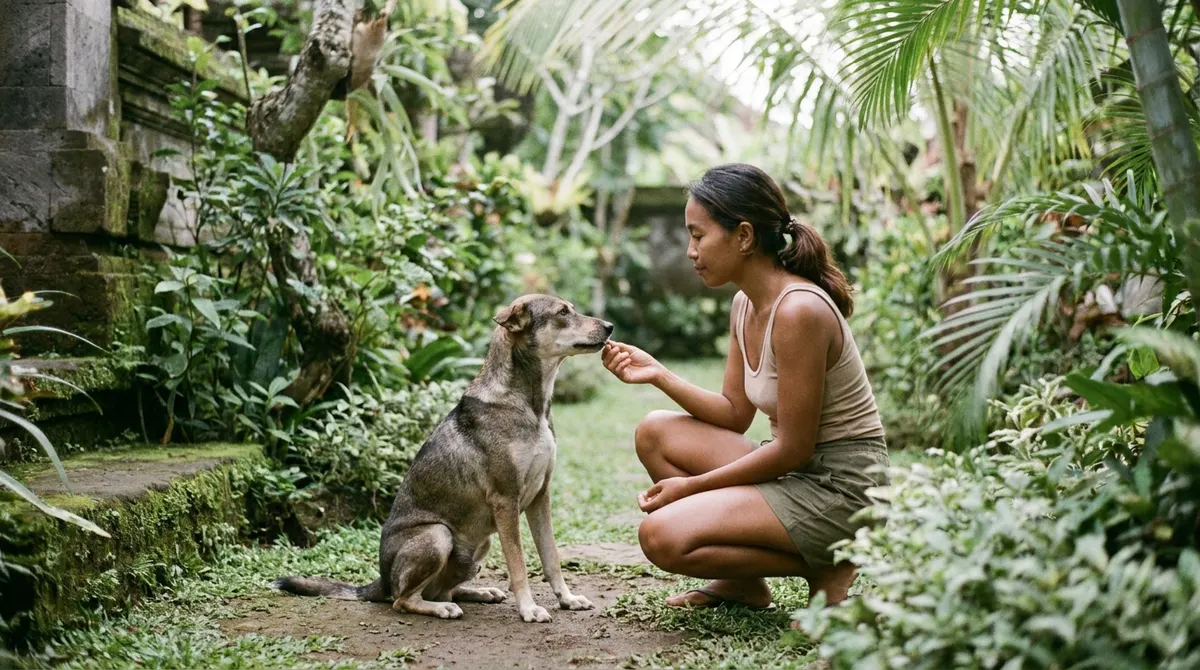
You just adopted a rescue dog from BAWA or Bali Dog Adoption. Or maybe your puppy has discovered the joy of chewing your favorite sandals. Or perhaps your adult dog has decided that "come" is optional when there's a chicken to chase. Whatever brought you here — finding the right dog trainer in Bali is harder than it should be.
The island has a mix of old-school trainers using dominance-based methods and a growing number of modern trainers embracing positive reinforcement. The approach you choose has enormous consequences for your dog's wellbeing and your long-term relationship with them. This guide explains the difference, what actually works, and how to find a trainer whose methods you can trust.
The Two Training Philosophies
Nearly all dog training falls into one of two camps. Here's what they actually mean:
Positive Reinforcement (Reward-Based)
Core idea: Reward the behaviors you want. Ignore or redirect the behaviors you don't. The dog learns that good things happen when they make good choices.
Tools used: treats, toys, praise, clickers, target sticks, harnesses, long lines. No choke chains, prong collars, shock collars (e-collars), or physical corrections.
This is the method used by: guide dog organizations, military working dog programs, search-and-rescue, most veterinary behaviorists, and every major international certification body (CCPDT, IAABC, KPA).
Aversive / Dominance-Based (Traditional)
Core idea: Correct unwanted behaviors through discomfort or intimidation. The dog learns to avoid the correction by doing what the trainer wants.
Tools used: choke chains, prong collars, shock collars (e-collars), alpha rolls (forcing the dog onto their back), leash jerks, scruff shakes, yelling, spray bottles, throw chains.
This is the method still used by: some local trainers in Bali, some "balanced" trainers (a mix of rewards and corrections), and trainers who learned their craft before the scientific consensus shifted (pre-2000s methodology).
Why Positive Reinforcement Wins (The Science)
This isn't a matter of opinion or "being soft." The scientific consensus is clear: positive reinforcement is more effective, longer-lasting, and safer than aversive methods.
1. It Actually Works Better
A 2020 meta-analysis published in the Journal of Veterinary Behavior reviewed 17 studies and concluded: "The use of aversive-based training methods is associated with poorer welfare and worse behavioral outcomes." Dogs trained with positive methods learned faster and retained commands longer.
2. It Doesn't Create New Problems
Shock collars and physical corrections suppress behavior through fear — but they don't teach the dog what TO do instead. A dog shocked for barking at other dogs doesn't learn to be calm; they learn that other dogs predict pain. This creates fallout: increased anxiety, aggression redirected at owners, learned helplessness, and breakdown of the human-dog bond.
3. It Builds Trust, Not Fear
A dog trained with rewards wants to work with you. They see you as a source of good things. A dog trained with corrections obeys to avoid punishment. The difference shows in their body language: relaxed, wagging, eager vs tense, tucked tail, avoidance.
4. It's the International Standard
The American Veterinary Society of Animal Behavior (AVSAB), the European College of Animal Welfare and Behavioural Medicine, and the RSPCA all formally recommend positive reinforcement and explicitly advise against aversive methods. This isn't a fringe opinion — it's the mainstream scientific position.
What Dog Training Actually Looks Like in Bali
In Bali, you'll encounter several types of trainers. Here's how to tell them apart:
| Trainer Type | Methods | Typical Price | Best For |
|---|---|---|---|
| Positive Reinforcement Trainer | Reward-based, force-free, science-backed | IDR 250K - 500K / session | Puppies, reactive dogs, building confidence, family pets |
| "Balanced" Trainer | Mix of rewards + corrections (prong/e-collar) | IDR 200K - 400K / session | ⚠️ Not recommended by veterinary behaviorists |
| Traditional Local Trainer | Dominance-based, physical corrections | IDR 100K - 250K / session | ❌ Avoid — outdated methods, high risk of harm |
| Board-and-Train | Varies — ask detailed questions | IDR 3M - 8M / 2-4 week program | Only if you've verified their methods are force-free |
Prices are for private 1-on-1 sessions in South Bali. Group classes, where available, are typically cheaper.
Common Training Challenges in Bali
Rescue Dogs from Local Shelters
Bali has a large population of rescued street dogs — many adopted through organizations like BAWA, Bali Dog Adoption, and Mission Paws'ible. These dogs often arrive with unknown histories, fear of humans, or street-smart survival behaviors. Positive reinforcement is essential for these dogs — they've experienced enough aversive stuff already. Building trust through patience and rewards transforms them into confident, loving companions.
Reactive Dogs in a Stimulus-Rich Environment
Bali's streets are sensory overload for a reactive dog: motorbikes, chickens, street dogs, cats, kids, ceremonies, loudspeakers. Counter-conditioning (pairing triggers with high-value treats at a safe distance) is the gold-standard approach. Aversive corrections for reactivity almost always make it worse — the dog associates the trigger with the punishment, intensifying their fear.
Puppy Socialization in the Tropics
Bali's outdoor lifestyle is great for socialization — but it has to be done right. The critical socialization window (3-16 weeks) is when puppies need positive exposure to everything they'll encounter as adults: motorbike sounds, Balinese ceremonies, other dogs, kids, different surfaces (sand, tile, grass). The key is positive exposure — not just exposure. A puppy flooded with scary experiences isn't socialized; they're traumatized.
What to Expect from a Professional Training Session
A good training session in Bali should look something like this:
- Initial consultation (60-90 min) — The trainer comes to your home, meets your dog in their familiar environment, and discusses your goals, concerns, and your dog's history. They should ask about diet, exercise, health, and daily routine — not just behavior problems.
- Assessment & plan — They observe your dog (and you) interacting naturally. Then they create a written training plan with specific, measurable goals — not vague promises like "your dog will be obedient."
- Hands-on session (45-60 min) — The trainer demonstrates techniques, then coaches YOU through practicing them. The best trainers spend more time teaching the owner than the dog — because you're the one who needs to reinforce the training every day.
- Homework — You'll leave with clear, achievable practice exercises for the days between sessions. Training happens in 5-10 minute sessions, multiple times a day — not in one marathon session.
- Follow-up & progress tracking — Regular check-ins (WhatsApp video reviews work great), adjusting the plan as your dog progresses. Most behavior issues improve significantly within 4-6 sessions; complex cases take longer.
Questions to Ask Any Dog Trainer Before Booking
Before you hire a trainer in Bali, ask these questions. The answers will tell you everything you need to know:
- "What training methods do you use?" — Listen for "positive reinforcement," "force-free," "reward-based," "LIMA" (Least Intrusive, Minimally Aversive). If they say "balanced" or can't name their methodology clearly, dig deeper.
- "Do you use prong collars, choke chains, or e-collars?" — If the answer is yes to any of these, walk away. These tools cause pain and fear, full stop.
- "What certifications do you hold?" — International certifying bodies include CPDT-KA, KPA-CTP, IAABC, and CTC. Bali-specific experience matters too — ask about their experience with street dogs, tropical environment, and local culture.
- "Can I watch a session before booking?" — Any trainer confident in their methods will let you observe. If they refuse, that's a red flag.
- "What's your approach for [your dog's specific issue]?" — Whether it's leash pulling, reactivity, or separation anxiety, the trainer should articulate a clear, humane plan — not just "I'll fix it."
- "How do you handle mistakes or 'bad' behavior?" — The right answer is management, redirection, and teaching an alternative behavior. The wrong answer involves any form of punishment, correction, or intimidation.
Dog Training at Home: What You Can Start Today
While you're searching for the right trainer, here are three exercises you can start immediately. All you need is treats and 5 minutes:
1. The Name Game (Attention)
Say your dog's name in a happy voice. The instant they look at you, mark with "yes!" and give a treat. Do this 10 times. Your dog learns that their name = look at you = good things happen. This is the foundation of all training.
2. Sit for Everything (Impulse Control)
Before meals, before opening the door, before putting on the leash — ask for a sit. Your dog learns that calm, polite behavior is how they get what they want. No pushing, no forcing — just wait. They'll figure it out.
3. Find It (Mental Stimulation)
Toss a treat on the ground and say "find it!" Your dog uses their nose, which is mentally exhausting in the best way. 10 minutes of sniffing = 30 minutes of walking in terms of mental energy burned. This is a lifesaver for high-energy dogs on rainy days.
DogCareBali Training — Force-Free, Science-Backed
My approach to dog training is 100% positive reinforcement. Here's what that means when you work with me:
- No aversive tools — ever. No prong collars, no choke chains, no shock collars, no physical corrections. Only harnesses, long lines, treats, toys, and praise.
- I train you as much as your dog. Most sessions are spent coaching you through techniques so you can replicate them every day. The goal is a dog who listens to YOU, not just the trainer.
- Customized plans. Your dog's breed, history, personality, and your lifestyle shape everything. A Husky needs different strategies than a Chihuahua. A rescue street dog needs a different approach than a puppy from a breeder.
- Realistic expectations. Behavior change takes time. I'll tell you honestly what's achievable in weeks vs months. No magic solutions, no "guaranteed in 3 sessions" nonsense.
- Ongoing support. WhatsApp check-ins between sessions. Video reviews of your practice. Training doesn't stop when the session ends.
Price: IDR 250,000 per session (60-75 min) at your home or a quiet outdoor location in South Bali. Package of 4 sessions: IDR 900,000. Initial consultation included free with your first booking.
Whether you have a new puppy, a reactive rescue, or a dog who just needs to learn some manners — message me on WhatsApp and tell me about your dog. We'll figure out a plan together 🐾